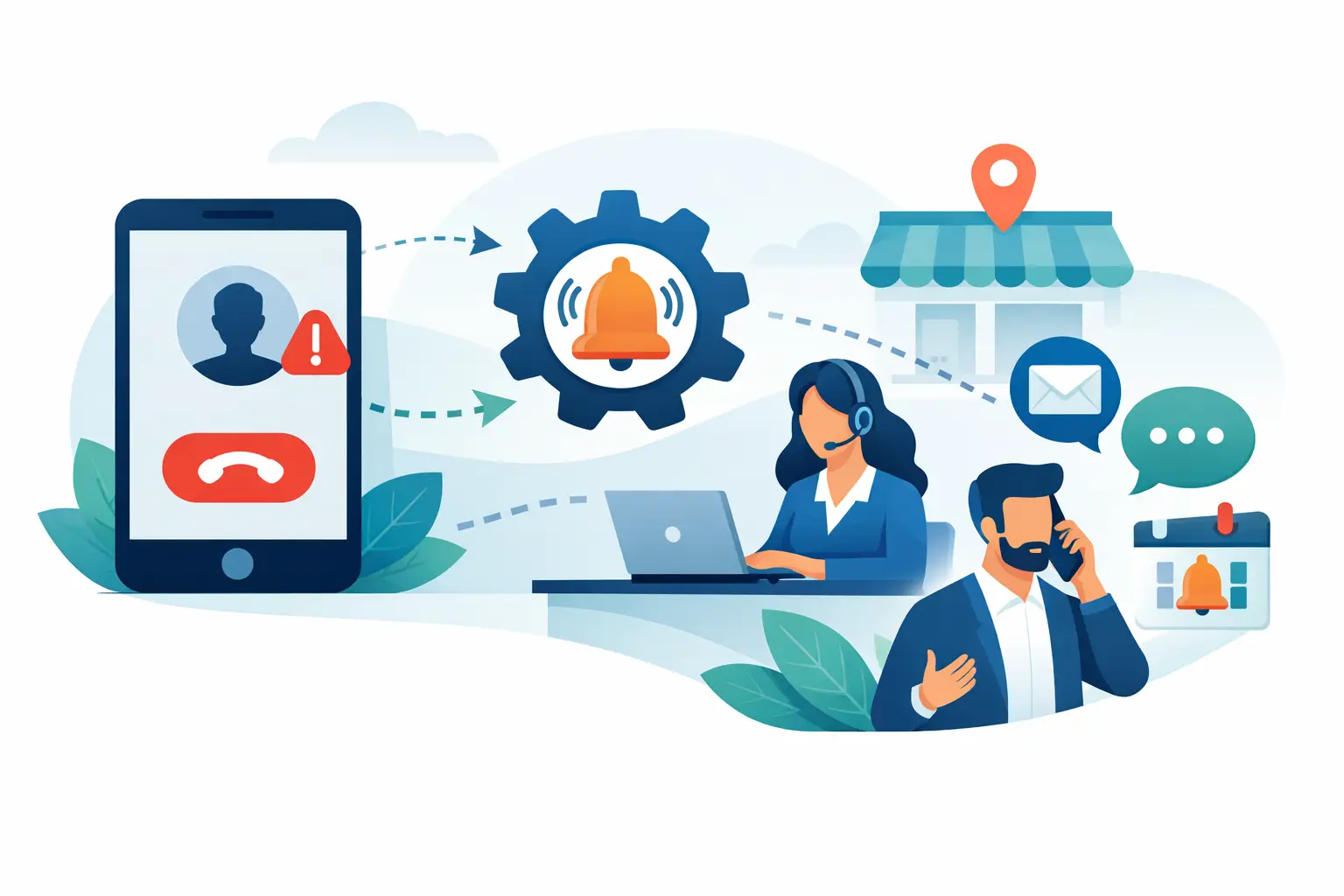
A missed call at 10:17 a.m. does not stay a missed call for long. It turns into a booked job with a competitor, a lost estimate, or a customer who never calls back. For service businesses that live on inbound calls, missed call automation for local businesses is not a nice add-on. It is a revenue recovery system.
Most owners already know they miss calls. What they usually do not know is how expensive those misses are over a month, a quarter, or a year. One missed roofing lead may be worth thousands. One missed plumbing call can mean an emergency job that goes elsewhere in five minutes. One missed dental inquiry can cost a new patient with years of future value. The problem is not just call volume. It is response consistency.
Why missed calls cost more than you think
Local businesses lose money in two ways when calls go unanswered. The first loss is obvious: the lead does not book. The second loss is quieter and often bigger: the customer experience starts badly, which reduces trust, follow-up, and future reviews.
That matters because people calling a local business are usually ready to act. They are not browsing casually. They need an appointment, a quote, a table, a technician, or a fast answer. If no one picks up, many will move to the next option on Google without hesitation.
This is where owners get trapped. They assume the issue is staffing, but staffing alone rarely fixes it. Calls are missed during lunch, while helping customers in person, after hours, on weekends, during peak season, and when the front desk is simply overloaded. Even good teams miss revenue when the phone rings at the wrong moment.
What missed call automation for local businesses actually does
At a practical level, missed call automation for local businesses creates an immediate response when your team cannot. That can include answering the call with an AI receptionist, sending an instant text back to the caller, collecting booking details, routing urgent calls, and following up until the lead either books or opts out.
The value is not the automation itself. The value is speed.
A local customer who gets a fast response feels acknowledged. That one shift changes what happens next. Instead of a dead end, the caller gets a path forward. Instead of leaving a voicemail no one checks until later, they can confirm what they need, request a quote, or start the booking process right away.
For many businesses, text plays a major role here. People often prefer to reply by text once they have made initial contact. If they call and miss you, an immediate text response can keep the lead alive. It lowers friction and gives the customer a quick way to continue the conversation without waiting on hold or calling again.
The best use case is not what most owners expect
Many businesses assume after-hours coverage is the main win. It is a win, but it is not the biggest one.
The bigger opportunity is daytime overflow.
That is when the front desk is busy, the owner is in the field, or the office manager is juggling three tasks at once. These are not unusual breakdowns. They are normal operating conditions for small and midsize businesses. The problem is that normal chaos creates preventable revenue loss.
A system that catches those calls in real time can outperform a business that only focuses on nights and weekends. Why? Because daytime callers are often high-intent leads contacting multiple providers at once. The first business that responds professionally has an edge.
Where automation helps most
Businesses that benefit most usually share three traits. They depend on inbound calls, they sell high-value services, and they do not have perfect front-desk coverage.
That includes contractors, med spas, dental offices, legal practices, HVAC companies, plumbers, electricians, home service brands, auto service shops, and other local operators where one missed lead can be worth far more than the monthly cost of a system.
It also helps businesses with strong search visibility. If you are already paying for ads, SEO, local listings, or reputation management, missed calls quietly weaken your return. You are paying to make the phone ring, then losing revenue when no one answers.
What to look for in a missed call automation system
Not every solution is worth installing. Some tools simply send a generic text and stop there. That may help a little, but it does not solve the actual workflow problem.
A better system handles the full chain. It should respond instantly, sound professional, collect useful customer details, route urgent situations correctly, and support review generation after the job is done. That last piece matters more than many owners realize.
If your call handling improves but your review flow does not, you only solve half the problem. Local growth depends on both response speed and public trust. More answered opportunities should lead to more completed jobs, and more completed jobs should lead to more quality reviews.
This is why Digital Workforce 360 positions automation as revenue recovery rather than software for software's sake. The strongest systems do more than pick up missed demand. They also strengthen the reputation loop that drives future demand.
The trade-offs owners should understand
Automation is not magic, and it is not one-size-fits-all.
If your business handles highly sensitive conversations, complex intake, or unique edge cases, the system needs tighter scripting and smart escalation rules. A law firm, for example, may need different handling than a pest control company. A med spa may want the tone to feel polished and consultative, while an emergency plumber needs urgency and speed.
There is also a line between automation and handoff. Good automation does not try to replace every human interaction. It should capture, qualify, and move conversations forward, then hand off when a real person is needed. When owners expect it to do everything, they usually design a system that feels stiff. When they use it to remove delays and create consistency, results are much stronger.
How to measure whether it is working
The wrong metric is how many calls were answered by automation. The right metric is how much revenue was recovered.
Start with a few basic numbers: total missed calls, percentage of missed calls that turned into conversations, percentage that turned into appointments, average job value, and review volume before and after rollout. These numbers tell a clear story.
If your business misses 40 qualified calls a month and even a modest percentage of those become booked jobs through immediate follow-up, the financial impact adds up quickly. For businesses with larger ticket sizes, the return can be obvious within weeks. That is why owners should treat this as an operations and growth investment, not just a communications tool.
You should also look at response time. Going from a two-hour callback window to an instant response changes lead behavior. In local markets, speed often beats polish. A fast, competent first response is usually more valuable than a perfect callback that comes too late.
Why reputation and call automation belong together
Most local businesses treat reviews and phone handling as separate issues. They are not.
The customer journey starts with the first contact and ends with the public proof left afterward. If the intake experience is inconsistent, the whole journey gets weaker. If the follow-up after service is inconsistent, review volume stays low. When both problems are fixed together, growth becomes more predictable.
That is the real advantage of tying missed calls to review recovery. You do not just save leads at the top of the funnel. You also turn completed work into trust signals that help the next customer choose you faster.
The businesses that move first usually win
Most owners wait until missed calls become painfully obvious. By then, they have already trained the market to expect slow responses.
The better move is to fix it before the next busy season, before the next ad campaign, and before another lead goes cold because the team was tied up. Local markets are competitive, and customers are impatient. A business that responds first, follows up consistently, and earns reviews steadily has an advantage that compounds.
If your phone is part of how you make money, every unanswered call deserves the same attention as a lost sale at the counter. The businesses that treat it that way usually do not need more leads first. They need to stop leaking the ones they already have.