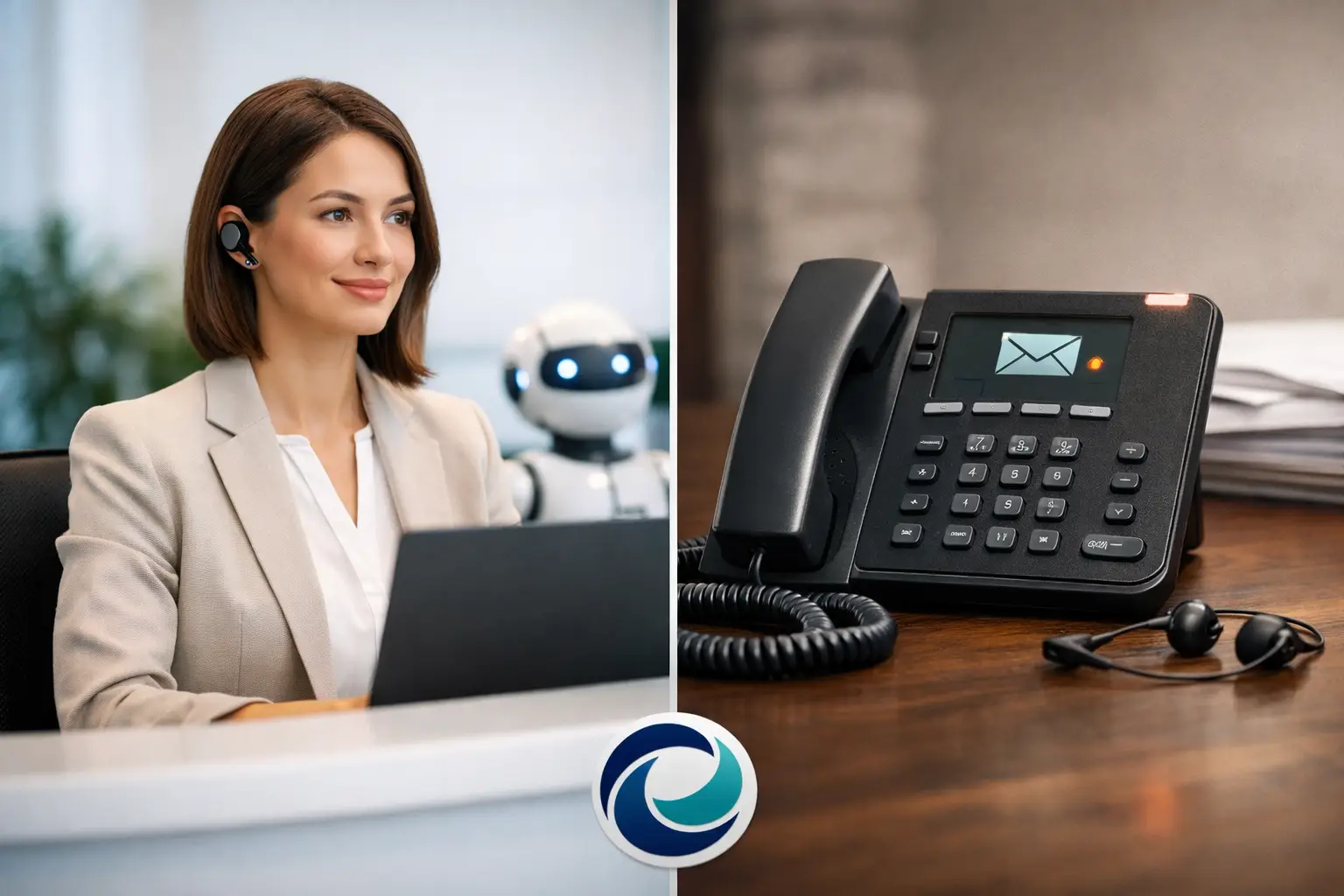
A missed call at 2:17 p.m. rarely feels dramatic in the moment. Then the day ends, the callback list gets longer, and one of those callers books with a competitor who answered and responded. That is the real issue behind ai receptionist vs voicemail. This is not about phone etiquette. It is about whether your business has a revenue system in place or a dead end.
For most businesses, voicemail has become a quiet leak in the sales process. It was acceptable when customers expected to wait. They do not anymore. If someone calls a law office, med spa, HVAC company, dental practice, roofing company, or home services business, they usually want one of three things right now: pricing, availability, or a fast next step. Voicemail delays all three.
An AI receptionist changes that equation. Instead of asking callers to leave a message and hope someone gets back to them before they move on, it answers instantly, handles the conversation, qualifies the lead, books the opportunity or routes the call flow toward an outcome. That outcome might information capture, or escalation. The main difference is simple: voicemail records demand. An AI receptionist converts it 24/7.
AI receptionist vs voicemail: the core difference
Voicemail is passive. It takes a message and puts the burden back on your team. Every result depends on whether someone listens to it quickly, understands it clearly, and follows up before the caller moves on. In a busy operation, that chain breaks all the time. And that process only works if the caller leaves a message, 62% of consumers hang-up instead of leaving a message and immediately contact your competition.
An AI receptionist is active. It picks up 24/7, speaks with the caller, answers questions, gathers details, qualifies and books opportunities to your calendar and keeps the interaction moving. It eliminates the lag between customer intent and business response. That gap is where revenue disappears.
This matters most for businesses that rely on inbound calls and website visitors to drive appointments, estimates, consultations, or service requests. If the phone is part of your sales pipeline, voicemail is not a customer experience tool. It is a backlog creator.
What voicemail actually costs a growing business
Most owners do not think of voicemail as expensive because the feature itself is cheap. The real cost is in what happens after the beep.
First, 62% of callers don't leave a message and if they do, business callbacks are inconsistent. A message may sit for 30 minutes, three hours or days depending on staffing, lunch breaks, job sites, front desk traffic, or simple overload. Second, the caller may not leave enough context. Names get mumbled. Numbers get said too fast. Needs are vague. By the time your team returns the call, they are trying to reconstruct a conversation that never happened and that's if they recognize the number calling and answer.
Third, voicemail creates friction at the exact point when a prospect is deciding who feels easiest to work with. If one company answers and responds while another asks to leave a message, the one that answered and engaged feels more organized, more responsive, and more trustworthy. That perception is what builds trust and a strong reputation.
There is also a reputation impact that gets ignored. Customers judge business responsiveness as part of the service quality. If reaching your business feels slow or uncertain, that experience shapes reviews and referrals even before a sale happens.
Where a 24/7 AI receptionist earns its keep
An AI receptionist is not valuable because it sounds futuristic. It is valuable because it removes avoidable gaps in customer response.
When calls come in after hours, during lunch, during meetings, while staff are helping in-person customers, or when the front desk is already juggling too much, the AI still answers. That protects demand you already paid to generate through ads, SEO, referrals, signs, or word of mouth.
It also creates consistency. Every caller gets a professional first response. Every conversation follows a structure. Key details are collected instead of lost. That consistency matters because growth usually breaks at the handoff points. A business gets more leads, but the process for handling them stays manual and uneven.
For owner-led companies, this is where the math gets obvious. Hiring more front desk coverage is expensive. Leaving calls to voicemail is cheaper upfront but costly on the back end. An AI 24/7 receptionist sits in the middle as a revenue tool that improves coverage without adding another full-time salary.
AI receptionist vs voicemail for customer experience
Put yourself in the caller's position. If they hear a voicemail greeting, they know they are waiting. If they reach a live conversational system that can help immediately, they feel progress.
That difference affects conversion more than most businesses realize. People calling a local service business usually are not conducting deep vendor analysis. They are trying to solve a problem quickly. The business that reduces friction usually gets the job.
Voicemail asks the caller to do work. They have to explain themselves, trust that someone will respond, and stay available for a callback. An AI receptionist does the work for them. It engages, clarifies, and moves the conversation toward a next step while intent is still high.
That does not mean voicemail has no place at all. For very low-call-volume businesses with long sales cycles and highly specialized intake requirements, a voicemail box may still be acceptable as a backup. But backup is the right word. It should not be the main customer entry point for a business trying to grow with new customers.
The trade-off business owners should understand
There is one reason some owners hesitate to replace voicemail. They worry an automated voice solution will feel impersonal or frustrate callers.
That concern is fair. A bad phone system can absolutely create friction. If it is rigid, confusing, or obviously scripted, it can do damage. But that is not an argument for voicemail. It is an argument for using the right AI receptionist with the right setup.
The real comparison is not between perfect human service and AI. For many businesses, the real comparison is between AI answering and responding now or no one responding now. Between a guided conversation and a beep. Between capturing revenue and hoping it calls back.
That is why implementation matters. The best systems are designed around how your customers actually call, what they ask, and what outcomes matter most to your operation. If the system is built around your workflow, it feels helpful. If it is generic, it feels like software.
Which option wins on revenue
If your business depends on inbound calls, website visits and online reviews, the answer is not close.
Voicemail helps you document missed demand. An AI 24/7 receptionist recovers and converts it. Those are not the same business outcomes.
Think about the hidden chain reaction of a missed call. You lose the booking or estimate. You lose the immediate revenue. You may lose the lifetime value of that customer. You also lose the review that might have come from a good experience. One unanswered call can be worth far more than the value of the first transaction.
That is why a revenue-focused business should view phone coverage as part of growth infrastructure, not just office administration. If calls and website visits lead to appointments, and appointments lead to sales, your new opportunity handling process should be built like a sales system.
This is where Digital WorkForce 360 has the right framing. The conversation should not be about replacing voicemail because it is old. It should be about stopping revenue loss caused by response gaps that today's customers will not tolerate.
When voicemail is still acceptable
There are narrow cases where voicemail remains useful. If a business only receives a few non-urgent calls each week, and every call requires a specialist callback anyway, voicemail can still function as a secondary tool. It can also serve as a fallback layer if a call cannot be resolved through standard intake.
But acceptable is not the same as competitive. A system that merely collects messages is rarely the system that drives the most growth. If your competitors are faster, easier to reach, and more consistent on the phone, voicemail slowly puts you behind even if nothing feels broken internally.
That is the trap. Businesses often tolerate voicemail because the losses are invisible. No dashboard announces the customers who hung up and moved on. No report shows the jobs that were never booked because the first impression was a recording.
The better question to ask
Instead of asking whether voicemail still works, ask this: when a ready-to-buy customer calls your business, what happens next?
If the answer is wait, record, and callback later, there is room to improve because today's consumer expects an immediate response, we live in a 24/7 world. If the answer is immediate response, guided conversation, and a clear next step, you are much closer to protecting the revenue your marketing is already generating.
That is the real verdict in ai receptionist vs voicemail. One stores opportunity. The other captures it.
If your phones are part of how your business grows, the smartest move is not to hope callers leave better messages. It is to make sure they never reach a dead end in the first place. To determine your revenue loss due to voicemail, visit: www.DigitalWorkForce360.com or call us 24/7 at (561) 556-1405. We'll make your business 24/7 Customer Responsive in 72-hours for $479/month (that's $15.97 per day) plus $199 implementation. Thanks for your time!